
Are Smoothie Vending Machines Profitable in 2026?
A smoothie vending machine can be profitable in 2026, but the machine alone does not decide that. Profitability comes from selling enough cups per day at a price that clears the cost of fruit, refrigeration power, site rent and restocking, while the unit keeps running. The format fits venues with steady foot traffic and customers who already pay for fresh drinks, such as gyms, malls, campuses and busy pedestrian streets. Whether your unit clears those conditions depends on numbers only you can supply: your venue traffic, ingredient cost, site terms and machine quote. The smoothie vending machine configuration you choose sets the fixed-cost floor for that calculation.
Why smoothie machines follow different economics
A smoothie machine holds frozen fruit, dairy or plant-based liquids and fresh produce, so it cannot sit idle the way a snack or drinks machine can. Slow turnover does not just lower revenue; it raises waste and keeps the refrigeration system drawing power for stock that may not sell. That makes profitability more sensitive to cups sold per day than to the machine list price. Our breakdown of what drives vending machine profitability covers the general cost lines; smoothies add a spoilage and freshness layer on top.
The ingredient choice carries a direct trade-off. Frozen fruit keeps longer and produces a more consistent cup, but it needs reliable freezer capacity and continuous power. Fresh produce supports a premium story and a cleaner label, yet its usable window is shorter and waste rises quickly when daily volume drops. Neither choice is cheaper in every venue. Match the ingredient format to your measured turnover.
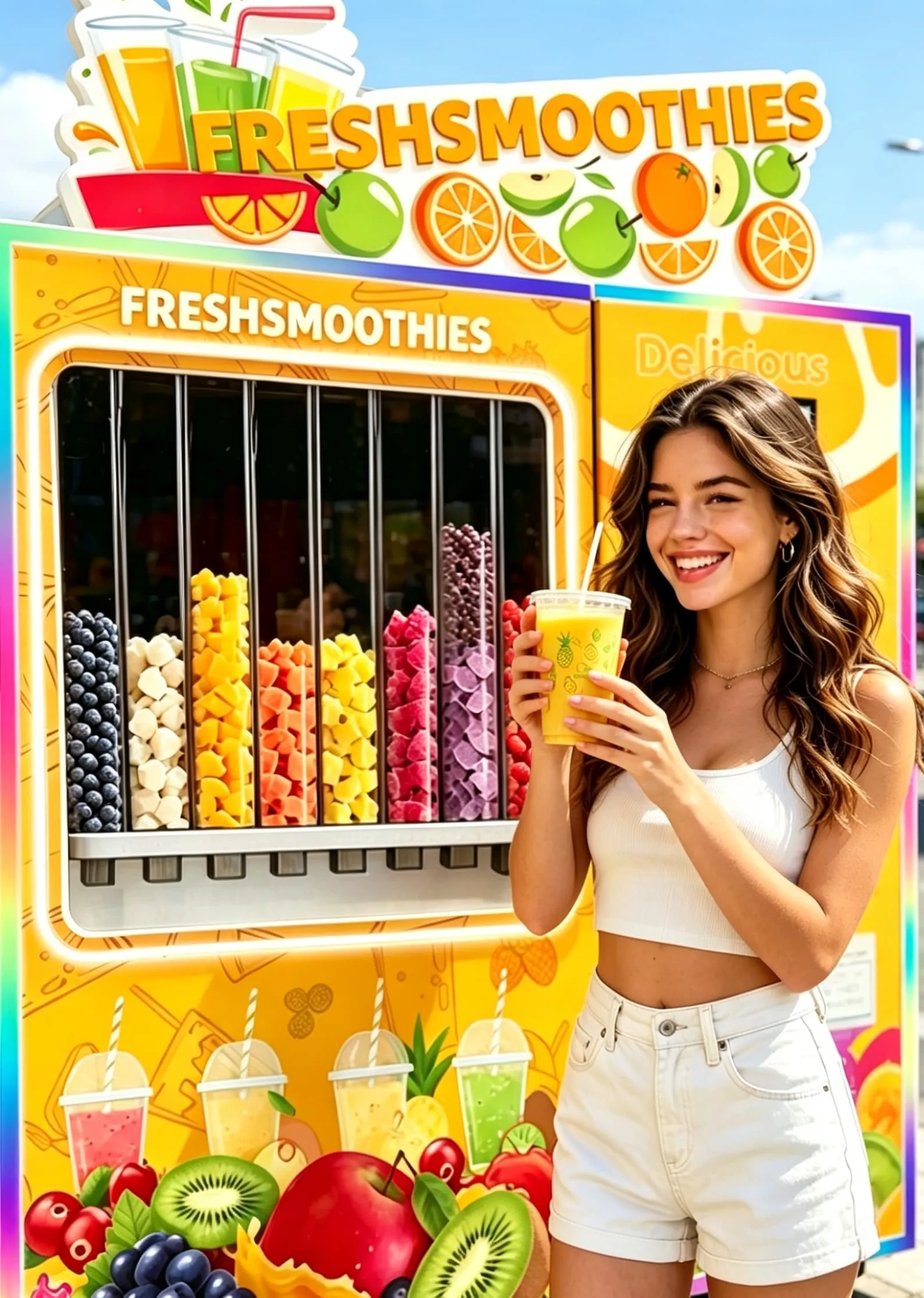
Run the break-even math before you buy
Before comparing machine models, build a break-even model for one unit. It uses four inputs you can obtain before purchase: your planned price per cup, your cost per cup, your monthly fixed cost and your realistic cups per day. The smoothie vending machine range gives you the configuration options, but the arithmetic is yours to run.
Contribution per cup = price per cup − ingredient cost − packaging − payment fee.
Break-even cups per day = monthly fixed cost ÷ (contribution per cup × operating days per month).
| Line item | What to plug in | Why it changes the decision |
|---|---|---|
| Price per cup | Your menu price for a standard serve | Sets contribution; a small price change swings break-even volume more than most buyers expect |
| Ingredient cost per cup | Supplier quote plus your measured portion | Fruit and dairy are the largest variable cost and vary by season and region |
| Packaging | Cup, lid, straw and sleeve quote | Easy to overlook; charged on every cup and can wipe out a thin margin |
| Payment fee | Your card and QR processing rate | A cashless-heavy site pays this on most transactions |
| Machine cost | Quote amortized over expected service life, or lease payment | Defines the fixed cost you must cover every month |
| Site rent or commission | Venue contract: fixed rent or revenue share | Fixed rent raises risk in low season; revenue share lowers it but cuts the upside |
| Power | Local tariff multiplied by machine draw and run hours | Refrigeration runs continuously, so power is a standing cost, not a per-cup one |
| Restocking and cleaning labor | Hours per visit, visits per day, labor rate | Scales with the number of machines, not with sales |
| Maintenance and waste | Service plan plus a waste allowance | Downtime and spoiled stock can erase an otherwise positive margin |
Swipe horizontally to view the full table.
Run two versions of the model: a conservative case and a base case. In the conservative case, use the lower of your weekday and weekend traffic and a capture rate you have actually observed at comparable venues. If break-even volume is above what the venue can realistically deliver, a cheaper machine will not rescue the site. Raising price lifts contribution but can lower capture, so test two price points before committing to a menu.
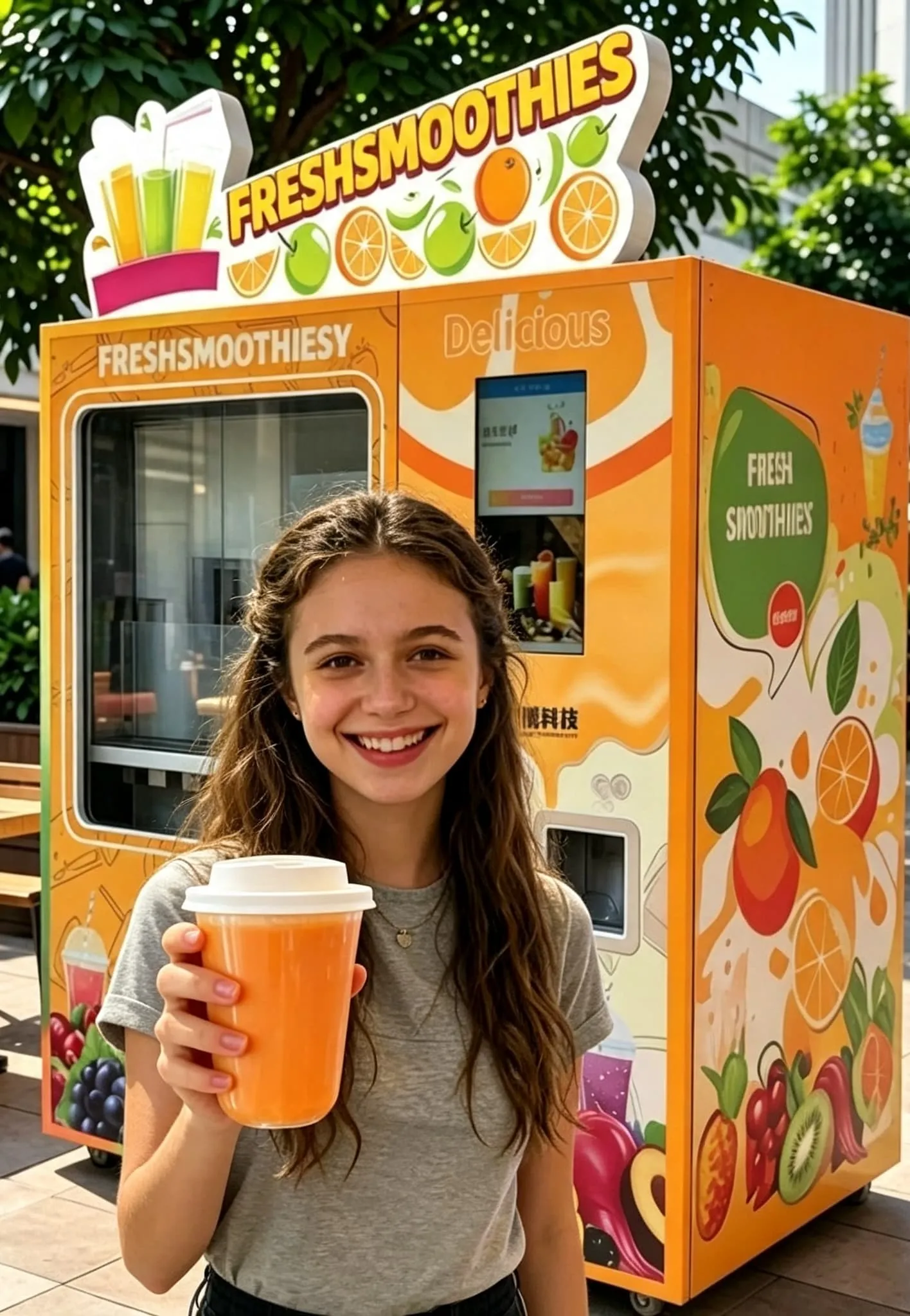
How machine configuration moves the numbers
Configuration is where a supplier can make your model more or less accurate. The fresh smoothie vending machine and the standard robot model share a 170 × 100 × 225 cm footprint and a maximum draw of 1,500 W, so the space and power costs you model should be built around those figures, not around a generic kiosk.
| Specification | What it means for your numbers | Confirm before ordering |
|---|---|---|
| Footprint 170 × 100 × 225 cm | Floor space carries rent and can limit site options | Door width, lift size and service clearance at the venue |
| Power, maximum 1,500 W | Refrigeration drives standing electricity cost | Available supply and whether a dedicated circuit is needed |
| Refrigeration and freeze preservation | Protects freshness and reduces waste, but draws power continuously | Preservation setup matched to your turnover and restock cycle |
| Cloud backend monitoring | Cuts labor per machine and shortens fault response | Dashboard features, alerts and data export you will actually use |
| Payment: coin, bill, card, QR, change output | Payment mix sets processing fees and cash handling | Processor terms and the split you expect in your market |
| Preset recipes and DIY combinations | Presets protect speed and consistency; DIY can raise the average ticket but can slow service | How much menu setup support is included |
| Multilingual touchscreen | Affects adoption where several languages are spoken | Language packages available for your market |
| Certifications: CB, CE, RoHS, UKCA, SAA, FDA | Determine whether you can import and deploy legally | Current certificate, issuing body and product scope for your destination |
Swipe horizontally to view the full table.
Menu width is a configuration decision with a cost. Adding a protein powder shake vending machine or a second drink format can widen the addressable customer base, but it also adds stock lines, restock time and spoilage exposure. Add a format only when measured demand at the venue supports the extra inventory turns. If you plan branded graphics, interface changes or a custom payment flow, OEM and ODM customization affects both the upfront cost and the time before production, so price it into the model rather than treating it as a free extra.
Where a smoothie machine earns its keep
Location decides more of the outcome than any specification. The strongest sites share a buying moment: customers are already in a leisure, health or waiting frame of mind and can see the machine. The vending machine applications used across the range point to malls, fitness centers, campuses, amusement parks and pedestrian streets, and each behaves differently.
- Gyms and fitness centers: health-aligned demand and repeat visits, but volume is concentrated in short daily windows.
- Shopping malls: high traffic and dwell time, usually at the cost of higher rent or a revenue share.
- Schools and campuses: predictable term-time demand, with long closures that must be modeled into annual fixed costs.
- Pedestrian streets and transport-adjacent sites: strong passing traffic, weaker dwell time and more weather exposure.
- Amusement parks and family venues: high weekend peaks, sharp seasonality and family-oriented menu preferences.
Screen a site on five points before signing: foot traffic during your actual operating hours, dwell time near the proposed spot, existing fresh-drink competition and its price, access to power and restocking, and the site terms. Treat a site as a poor fit when traffic is low and dwell is short, when a cheaper smoothie counter already owns the location, or when restocking access is limited to hours outside your service window. The core trade-off is rent against volume: a mall can carry a higher commission if it delivers the cups, while a gym with lower rent only works if its concentrated windows clear break-even.
De-risking the purchase before you commit
Pilot one unit before ordering a fleet. Set a go or no-go threshold in advance: cups per day, waste as a share of stock and uptime over the first weeks. A single instrumented machine tells you more about capture rate and spoilage than any forecast. Factory-direct manufacturing and service support matter here because uptime and spare parts availability decide whether a good site stays profitable.
Ask the supplier for a specific document set before you sign: the technical sheet, power and space requirements, the preservation configuration, a spare-parts list, the service and training scope, the certification scope for your market, and how lead time is calculated. Each item changes either your fixed cost or your downtime risk. Restocking labor deserves its own line in the model, because a machine that needs two visits a day behaves very differently from one that needs one, especially once you operate more than a single site.
FAQs
What daily cup volume does a smoothie vending machine need to break even?
There is no universal number, and any supplier who quotes one without your cost data is guessing. Divide your monthly fixed cost by your contribution per cup and by your operating days to get break-even cups per day. Use your own machine quote, site terms and ingredient cost, then run a conservative and a base case. If the required volume is above what the venue can realistically deliver, the unit will not pay back, whatever the machine costs.
Do smoothie machines waste a lot of ingredients?
Waste depends on turnover and storage, not on the category as a whole. Machines with refrigeration and freezing hold ingredients longer and keep cups consistent, but slow-selling stock still ages. Confirm the preservation configuration, the typical restock cycle and the spoilage controls with the supplier, then set reorder levels from measured daily sales rather than a fixed schedule.
Can I customize recipes, branding and payment for my market?
Yes. Configuration can cover preset formulas, customer DIY combinations, exterior colors and graphics, interface language, media and payment methods. Ask what is standard and what is custom, because custom tooling, artwork and payment integration usually add cost and time before production, and those belong in your break-even model.
Is a smoothie machine more profitable than an ice cream or snack machine?
Not inherently. Smoothies carry higher ingredient and spoilage exposure but can support a higher ticket in health-focused venues. Snacks cost less to stock and waste less but earn less per sale. Compare the options on the same venue using contribution per cup, expected daily units and fixed cost, rather than comparing list prices.
Which certifications matter for my market?
The machine is offered with CB, CE, RoHS, UKCA, SAA and FDA options, and the right set depends on your destination and on how you import or deploy. Request the current certificate, the issuing body and the product scope it covers, then confirm the requirement with your importer or local authority before shipping.
Turn Your Idea Into a Vending Machine People Remember.
Share your market, product concept and quantity. Our team will prepare a tailored OEM/ODM proposal.