
 EN
 es
 fr
 pt
 ru
 ar
 de
 ja
 ko
 he
 tr
 nl
 it
 pl
 uk
 sk
 th
 da
 ro
 sv
 lt
 bg
 fi
 hr
 no
 ga
 sl
How Much Profit Does One Smoothie Machine Make a Month?
One smoothie machine, one month, one honest answer: there is no single figure, and any supplier who quotes one before asking about your site is guessing. The monthly result comes from four inputs, and three of them belong to your location rather than to the machine. What the machine decides is the cost side. It sells unattended, keeps ingredients cold on board and reports sales and faults to a dashboard. No wages, no serving counter, no shop rent. That is why the arithmetic usually turns positive well before a site gets busy. A staffed smoothie bar needs volume to survive. A machine needs only enough cups to cover ingredients, power and its spot.
Why two identical machines earn different amounts
Placement decides more of the monthly result than configuration does. A cabinet in a 24-hour gym and a cabinet in a mall corridor run the same software, pour the same drink and behave like two different businesses.
The gym has two predictable peaks, early morning and after work, plus a membership that already buys protein drinks. The mall corridor has family traffic, weekend weight and impulse purchases from people who had not planned to drink anything. A campus has term dates and price sensitivity. A pedestrian street lives with weather.
Rank sites by repeated buying moments rather than by footfall. Five hundred people who pass twice a day, at hours when a cold drink is plausible, will usually beat five thousand strangers who pass once. The trade-off is that a strong site rarely comes free. Hosts ask for a flat fee, a share of revenue, or both, and terms differ enough between similar venues to flip a month from surplus to deficit. A free corner in a building with no buying moment is the most expensive site you can accept, because it costs you the month and the machine's attention.
The cost lines the machine does not carry
| Cost line | Staffed smoothie counter | Unattended smoothie machine |
|---|---|---|
| Wages | One or two people per shift, plus holiday cover | None for selling; you replenish on your own schedule |
| Selling space | Shop rent, deposit, service area | A 170 x 100 cm footprint, under two square metres |
| Fit-out | Counters, sinks, signage, refrigeration, point of sale | Colours, logo, screens and payment flow specified at order |
| Trading hours | Limited by staff and by the lease | Continuous, including nights and holidays |
| Consistency | Depends on who is on shift | Preset formulas, with customer mixing inside your limits |
| Oversight | A manager on the floor | Cloud dashboard for sales, status, faults and screen content |
Swipe horizontally to view the full table.
Read the left column as obligations and the right column as choices. Wages and shop rent arrive whether or not a customer does. Ingredient cost, packaging and payment fees arrive per cup. That shift from fixed to variable is the profit argument in one sentence: a quiet week hurts a machine operator far less than it hurts a shop.
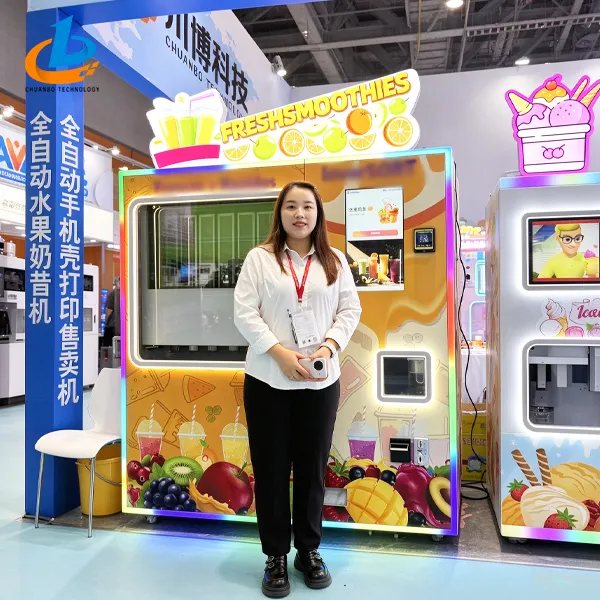
What does not disappear: ingredients, cups and lids, electricity (the cabinet draws up to 1,500 W), a venue fee or revenue share, payment processing, transport, and your hours for refilling and cleaning. The ssmoothie vending machine is built around that list, with on-board refrigeration for frozen fruit, fresh vegetables, protein powder and milk-based liquids, so stock keeps between visits without a daily produce run.
The four numbers that decide your month
- Cups per day. Traffic counts at the site during trading hours, converted at a conservative purchase rate. Not the machine's maximum throughput.
- Average price. Your market, your venue, your cup size. Not the price on a supplier's slide.
- Cost per cup. Ingredient dose plus cup, lid and straw. Ask for the tested dose per cup and how many cups one full stock set covers, since both change with the menu.
- Fixed monthly site cost. Venue fee or revenue share, electricity, payment fees, transport, and a realistic value for your time.
Break-even cups per day = (fixed monthly cost + target monthly surplus) / (price per cup - cost per cup) / 30
Two properties of this arithmetic matter more than the figures. The gap between price and cost per cup is wide because no wage sits inside the cup, which lets a modest daily volume carry a month. And small changes at the top of the fraction move the break-even volume a long way, so run the low case as well as the optimistic one. The same frame, applied to another cabinet, appears in this note on ice cream vending machine profitability.
Where one machine stops and a route starts
One machine is a test. The business is the third and fourth machine, and the reason is arithmetic rather than ambition. Most of your fixed cost is not per machine. A refill run costs fuel and an afternoon whatever it carries, and the cloud dashboard consolidates sales and fault alerts for every unit. Ten machines on one route can be run by one person with a checklist. Ten machines across three cities cannot.
Density has a ceiling. Two cabinets in the same demand pool, such as two corridors of one mall, split the same purchases and double the venue fees. Spread units across venues whose peaks fall at different hours, and the same operator hours carry more revenue. A weak site is also a relocation rather than a write-off, provided the venue agrees the unit may be moved.
Two models, one decision
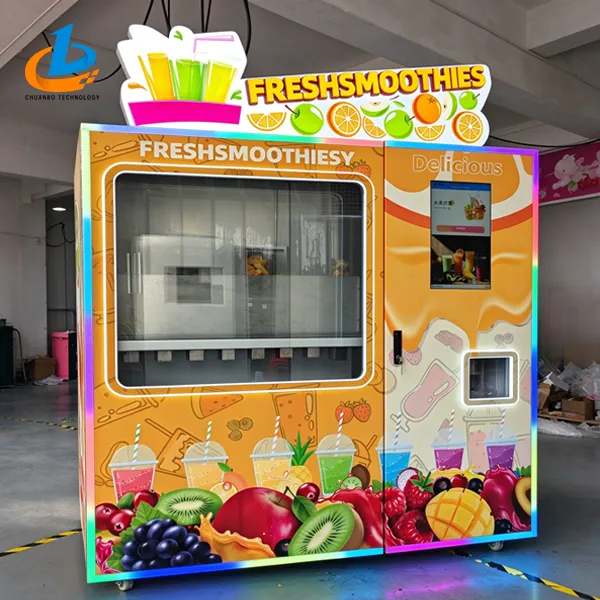
Chuanbo builds two versions on our website. Both use the 170 x 100 x 225 cm cabinet, draw up to 1,500 W, accept coins, bills, cards and QR payments with cash change, and report through the same cloud monitoring. The fresh smoothie vending machine adds a fruit-themed cabinet with visible ingredient compartments and a large multilingual touchscreen, so a passer-by can see what the drink is made of before deciding.
That display earns its place in a mall, a festival or a pedestrian street, where most customers had not planned to buy. In a gym, an office lobby or a campus, the visit already implies the purchase, so the cabinet has less selling to do.
What the machine needs from your site
- Space and access. 170 x 100 cm of floor, 225 cm of height, plus a delivery route and turning space. Measure the door before committing to the room.
- Power. Up to 1,500 W on a circuit the venue will let you use. Refrigeration runs continuously, so ask what happens during an outage.
- Conditions. Outdoor pitches need weather protection and shade. A cabinet in direct sun works harder to hold its temperature.
- Stock storage. Frozen fruit needs freezer space at or near the site. If stock lives in your car, range and quality both suffer.
- Contract. Fee or share, term, exclusivity, relocation terms, and who handles cleaning and minor faults.
Any one of these can disqualify a site that looks good on a traffic count. A strong pitch behind an 80 cm doorway is not a strong pitch.
What protects month six
The first month is a novelty month. The sixth month tells you what you own, and it is decided by uptime rather than by peak sales. On-board refrigeration keeps stock saleable between visits, which matters most in summer. Remote monitoring reports fault alerts and sales before a customer meets an empty cabinet. Spare parts availability decides whether a fault costs a day or a fortnight.
Certification belongs on the same list, because a machine that cannot be legally placed is not a slow month, it is no month at all. The documented set for these cabinets covers CB, CE, RoHS, UKCA, SAA and FDA, with the applicable certificate depending on the destination market. Ask for the current certificate, its scope and the exact model it covers rather than for a badge on a page.
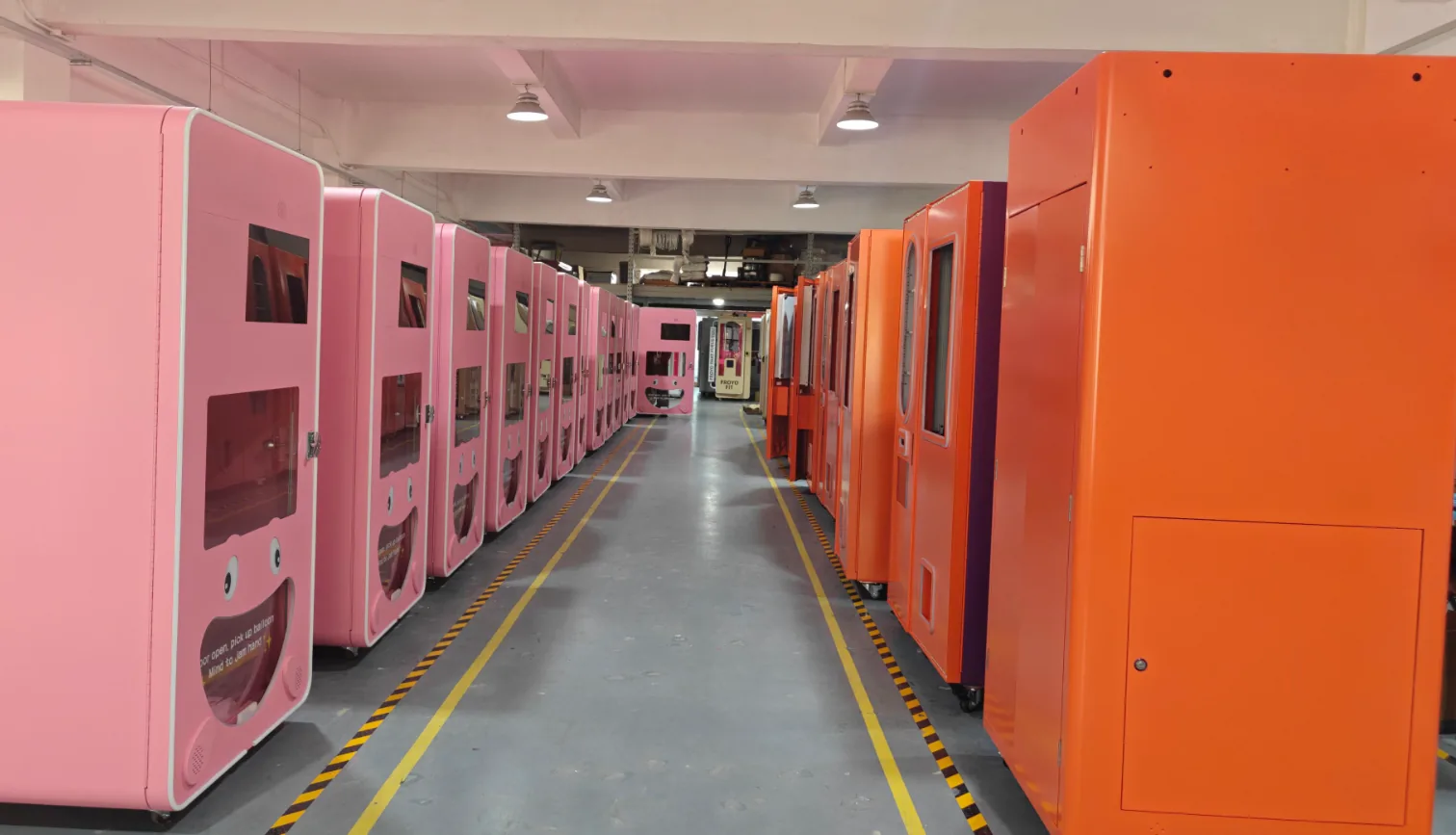
Factory-direct supply affects this more than buyers expect. Exterior colours, logo, interface language, screen media and payment flow are fixed at order, and OEM and ODM customization decides whether a venue gets a cabinet that matches its brand or a generic box in a corridor. Chuanbo has manufactured vending machines for over 20 years from a 10,000 square metre factory, which is the part of the offer that shows up later, in spare parts and configuration changes. The factory background covers that side.
Frequently asked questions
How much profit does one smoothie machine make in a month?
No fixed figure exists, and a supplier who quotes one without your site data is guessing. The result is set by cups sold per day, your price, your cost per cup and your fixed monthly site cost. What the machine changes is the structure: it removes wages and shop rent, which are fixed obligations, and leaves costs that appear per cup. Send the site details and the model can be built with your numbers.
Can one person operate several machines?
Yes. Selling is unattended and the dashboard consolidates sales, status and fault alerts across units. What scales with machine count is replenishment and cleaning, which is why route density matters more than cabinet count. Confirm stock capacity between refills before committing to a service interval.
Which certifications apply to my market?
The documented set covers CB, CE, RoHS, UKCA, SAA and FDA, and the applicable certificate depends on where the machine will be installed. Request the current certificate for the exact model and destination market, then check what the venue, insurer or local authority will ask to see.
Can the cabinet be branded and the menu localized?
Exterior colours, graphics, logo, interface language, screen media and payment flow are configurable at order, and drink formulas can be preset for your market. Share the venue type, the price point you intend to hold and the flavours you plan to sell, and the configuration can be matched to them rather than to a default menu.
What happens if a site underperforms?
A cabinet can be relocated, which is a different risk profile from a shop lease. Agree the relocation terms before signing, and check access and power at the new site before the move.
Turn Your Idea Into a Vending Machine People Remember.
Share your market, product concept and quantity. Our team will prepare a tailored OEM/ODM proposal.